Thursday, September 18, 2008

Roter Teufel

My good friend Christian down in Austin sent me a link to this YouTube audio clip of a really nice 1938 recording by the Barnabas von Geczy Orchestra, a very famous German band of the era. 

"Roter Teufel" translates to "Red Devil."  It is a great example of an upbeat "piano orchestra" dance band style that was apparently quite popular in Germany at the time and which had no real counterpart in American popular music.   I have heard other recordings in a similar vein by German bands such as Hans Bund and Otto Dobrindt.  I also have a few that someone found off the Internet and sent to me that I don't have title and artist credits for.   


Barnabas von Geczy was Hungarian and came to Berlin in 1924 where he led the band at the Hotel Esplanade from 1925 through 1937.   The von Gezcy Orchestra was very diverse musically and recorded everything from classical and "salon" music to tangos to popular dance band music. 

Back Again

The past several weeks have been hectic for several reasons.   I figured that made it a good time to take a little "vacation" from putting up Hit of the Week updates and blog postings.  Sometimes it is necessary to do that.  If my online music endeavors ever start to become more of a chore or a "duty" than fun - well, that is the day that I will pack it in and quit.  I find that taking a break every now and then is crucial to help keep things fun. 

Saturday, August 09, 2008

Son of Rifleman Grows Up To Become 1920s & 1930s Bandleader


The Johnny Crawford Dance Orchestra, a contemporary 1920s and 1930s style dance band based out of Los Angeles, has released a much anticipated CD featuring recordings of the band with vocals by Johnny Crawford recorded during live performances at the Los Angeles County Museum of Art and at the historic Gold Room of the Los Angeles Biltmore Hotel. You can purchase and stream tracks from the CD on its page at CD Baby.

Those unfamiliar with the Johnny Crawford Dance Orchestra might not be aware that they may already be familiar with its leader who was a 1950s and 1960s child television star and recording artist. Born into a show business family, Johnny got his television break at the age of 9 as a Mouseketeer on the Mickey Mouse Club. Big time fame and teen-idol status came with his role playing the son, Mark McCain, in The Rifleman which aired from 1959 - 1964 and for many years afterwards in reruns. During The Rifleman years, Johnny also had a record contract and one of his recordings "Cindy's Birthday" became a top ten hit.

On the band's myspace profile, Johnny describes how he became interested in 1920s and 1930s music.

But what I loved most during my youth, was acting in a western tv series, having my own horse, learning to rope, and playing Red River Valley on my harmonica. In my head, I was actually living in the 1880s, and I continued to live there even after two years in the army; as a young veteran, I couldn't resist the allure of rural America, and the excitement of participating in cowboy events at dusty arenas. My family was a little concerned.

Then, in my 26th year, I began a road trip from which I have never returned.

An antique automobile put me in touch with the spirit of my grandfather, Bobby Crawford (1889-1941). A former jockey from Chicago, the "dynamo song plugger" married the young pianist at Woolworth's and soon became vice president of Irving Berlin's music publishing company. Not satisfied, he left Berlin to form De Sylva, Brown & Henderson as well as Crawford Music Corporation, and moved his office into the penthouse of New York's famous Brill Building ("Tin Pan Alley"). He made a quick fortune. Then he lost it, even quicker, about the time my old car was rolling off the assembly line, in the "fall" of 1929.

I became possessed by my grandfather's spirit. I would find myself driving around in the middle of the night, hearing forgotten dance bands and singing songs I didn't even know I knew. Instead of the 1880s, suddenly I was living in the 1920s. I thought this was considerable progress, but my family was still a little concerned. So, after word got around, arrangements were made and two years were spent in an institution on the east coast known as Vince Giordano's Nighthawks, the notorious asylum for musicians lost in time.
I certainly can relate to being lost in a time warp. And, happily, Vince Giordano's Nighthawks are still going strong.

In addition to the band, Crawford owns Crawford Music Services, a music booking agency. On its website is a form where you can subscribe to a mailing list for updates about Crawford's activities.

Wednesday, August 06, 2008

Tuning In With A 1929 Edision Radio

A listener got in touch with me through Radio Dismuke's myspace profile to let me know about a YouTube clip he posted of his 1929 Edison R-4 radio playing Radio Dismuke.


Very nice!

Thursday, July 31, 2008

Waco Trip For Upcoming Broadcast

Recording the Texas Record Collectors' Party broadcast in Waco, Texas last weekend.


Last weekend I traveled down to Waco, Texas and met up with Matt From College Station and Christian Kohlhaas at the residence of Eddie The Collector to record an upcoming Texas Record Collectors' Party broadcast. The last time the four of us got together to record such a broadcast was in the summer of 2006 - so we were definitely overdue for one. Matt From College Station drove in from.... well, from College Station, of course. Christian came in from Austin. Each of us brought a nice big stack of 1920s and 1930s era 78 rpm records that had been pre-screened to exclude any recordings that are already in the Radio Dismuke playlist.

The broadcast will air sometime within the next month or two - exactly when depends on certain factors in my own personal schedule. Once a date has been set, I will certainly give plenty of advanced notice both here and in audio announcements on Radio Dismuke.

We had some additional fun besides the broadcast. Eddie took us on a walk-though of the restoration work on the lower floors of the historic Roosevelt Hotel in downtown Waco. The hotel in recent years had been used as a retirement home. Developers are now restoring the lower levels and ballroom to their original grandeur with plans for the upper floors to become offices.

After that we went to a nice spot on the campus of nearby Baylor University to enjoy 78 rpms outdoors under large trees with the portable wind-up phonograph Matt brought along.

We also visited an antique store located in a very neat 1909 house that was once the residence of the president of Dr. Pepper. Dr. Pepper was invented in Waco and was headquartered there during its early decades. We did find a pile of 78 rpms at the antique store - but they were mostly uninteresting late '40s and early '50s easy listening stuff. But I did pick up a copy of an Original Dixieland Jazz Band 78 rpm that I am pretty sure I did not already have and Christian got an interesting 1910s Columbia disc of a Serbian band.

Finally, we visited the soda fountain at the Dr. Pepper Museum and enjoyed Dr. Pepper sundaes. A Dr. Pepper sundae is vanilla ice cream topped with Dr. Pepper syrup. It probably sounds kind of gross to most people - but, in fact, it is very delicious and is a definite "must do" whenever one visits Waco.

We played a lot of great records on the broadcast so you will definitely want to check back for the announcement of when it will air.

I did bring my camera along and took pictures throughout the day. Here are a few of them. You can view the rest under the "view my pics" section on Radio Dismuke's myspace profile.


Matt's portable wind-up phonograph playing a mint condition Depression era Columbia blue wax disc.


Eddie The Collector with the wind up phonograph. A second wind-up can be seen in the background.

From left to right: Eddie The Collector, Christian, Matt From College Station on porch of 1909 house.

Me during the broadcast at Eddie's house.


Me announcing a recording while Matt From College Station changes records on the turntable in the background.


Christian pretending to chug down a bottle of Baby Percy Medicine, a patent medicine era remedy which is still made in Waco.


Matt From College Station announces an upcoming recording.


Our host Eddie The Collector, who generously made his house available for the broadcast, announces a recording.


Christian displays a bottle of Dublin Dr. Pepper made by the world's oldest Dr. Pepper bottling plant in the small town of Dublin, Texas. Unlike ordinary Dr. Pepper, Dublin Dr. Pepper is made according to the original recipe using cane sugar instead of corn syrup - and you can taste the difference. Dublin Dr. Pepper has become sort of a tradition during special Radio Dismuke broadcasts.


One of the vintage records Matt brought along from his collection was an unusual and extremely rare early 1920s marble wax Paramount disc.


Friday, July 25, 2008

Texas Themed Hit of the Week Update

Just a plug for this week's Hit of the Week Update by guest contributor Eddie The Collector. I think it is an especially good update - and all of the recordings have a Texas connection. Eddie features hard-to-find recordings and provides interesting background information about the Jimmy Joy Orchestra, a now all-but-forgotten territory band based here in Texas. In the 1920s, it was one of the most successful and highly regarded bands in Texas and it went on to achieve a certain amount of national fame.

For the update's Extra section, Eddie features vintage recordings of college fight songs from three famous Texas institutions - SMU, UT and Texas A&M - along with interesting background information about the history of the songs.

The update is currently featured at: http://dismuke.org/how. Once the next update is posted, Eddie's update will be archived under the July 24 entry at: http://dismuke.org/how/prev7-08.html.

19th Century Commercial Interior


There is another interesting posting at detroitblog - this one about an intact 19th century interior that survives on the top floor of an abandoned 119 year old commercial building. While the rest of the building has been remodeled during the course of many decades, the upper floor was used for storage and was largely ignored.

From the posting:

"Up here, there are square columns made of cast iron, lined across the middle of the floor in strict rows, beautifully painted and topped with lovely details. There are exuberantly layered moldings, piled one atop the other in a burst of whimsy. There are garish colors like turquoise and silver and magenta, and shades of gold everywhere. There is texture throughout, touchable elements to be experienced with more than one sense.

They do not design buildings like this anymore. A modern retail store would not go to such lengths to enchant their customers with such surroundings. These rooms are rare, immediate evidence that a world existed when people sought to make buildings beautiful both inside and out, just to do so."

Based on the photos, I can't say that I am all too fond of the color scheme - though perhaps it may look better in person. But the columns and details are very nice. And the poster's admiration for "a world when people sought to make buildings beautiful both inside and out just to do so" very eloquently captures a sentiment that I have felt ever since I was a child and noticed the enormous contrast between pre-World War II era buildings verses the disgracefully ugly stuff put up during the 1960s and 1970s that still dominated and blighted the landscape. And the spirit of that long-lost world manifested itself in far more than just its buildings.

I am extremely grateful for the advantages that the modern world has to offer in terms of medical advances, a much higher standard of living and the many technological achievements that make our lives easier and better in countless and often under-appreciated ways. But whenever I listen to old music, look at old buildings and old photographs, I cannot help but notice that something very special had become all but lost in our popular culture by the latter part of the 20th century. I am greedy: I want to live in a world that combines the very best of both eras.

Saturday, July 19, 2008

World's Oldest Blogger Dies At Age 108

Olive Riley, the world's oldest blogger has passed away at age 108. This is the first I have heard of her. From the announcement on her blog:

"Her example says; if a woman who left school in 1914, can embrace the internet in her 106th year, what is there you can’t do, friend?...I was gob smacked by this dame with a memory like a hard drive. At 104, Olive was able to remember conversations she’d had in 1908 and bring them to life. Amazing!"


I'll bet it would have been fun to talk with her about old times.

Thursday, July 17, 2008

Vince Giordano & His Nighthawks At Hotel Edison


Via Andy at Radiola! I've learned that Vince Giordano And His Nighthawks have a long-term engagement at Sofia's Restaurant in New York's Hotel Edison.

Catching a performance of The Nighthawks is definitely a "must do" for any 1920s and 1930s music fan's visit to New York City. I got to attend one of their performances in 2005 - and it was a wonderful treat to hear 78 rpm era popular music performed live and in a highly authentic manner without the technological limitations of 78 rpm records. Those not familiar with the band might recognize it from the film The Aviator (which I haven't yet seen - but it is on my "to watch someday" list).

While I have never been to Sofia's Restaurant, the Hotel Edison was one of a number of old art deco skyscrapers that I have visited on my trips to the city. The hotel was built in 1931 and is certainly an appropriate venue for Giordano as a great many of the old "Golden Era" 1930s bands performed at The Edison.

This Old House


From Detroitblog, the sad story of the decline of a once-grand house and its neighborhood.

Sunday, July 13, 2008

The Wonderful World of Hans Fischerkoesen

A few years ago I discovered and became a big fan of the German cartoonist Hans Fischerkoesen.

Fischerkoesen established his own production company in the 1920s and specialized in advertising cartoons that were shown between features in cinemas. Though Fischerkoesen was very much not a supporter of the National Socialist regime, the advertising nature of his output enabled him to work without a lot of interference from Nazi censors. In 1941, however, Propaganda Minister Goebbels ordered him to collaborate with the German film monopoly UFA for the production of propaganda films - and in those films he was able to sneak in very subtle and implicit jabs against the Nazis. At the end of the war he was arrested by Russian troops on suspicion of being a Nazi collaborator and was held for three years at Sachsenhausen, a former Nazi concentration camp that had been taken over and put back into use by the Russians. In 1948 Fischerkoesen was tried, exonerated and released. Since he was not a communist, however, he was not permitted to work in the East German film industry. He and his wife managed to escape to West Germany where he was able to resume making advertising films and did so through 1969. He died in 1973.

Fisherkoesen's cartoons have an incredible charm about them. Here is one of my favorites. It is a 1937 advertisement for Phillips light bulbs. I especially enjoy the scenes of the animals, insects and flowers.


Here is a 1933 cigarette advertisement in black and white where cigarette smoke is transformed into a ballet:


Finally, here is one of Fischerkoesen's most famous cartoons, Weather Beaten Melody from 1942. The premise of the cartoon is a bee who discovers an abandoned phonograph player left over from a pre-war picnic and is able to revive the spirit of happier and less troubled times. A rather lengthy article at this link talks about some of the implicit anti-Nazi elements in the cartoon - though, in some cases, I think the author is stretching things a bit. Here, too, the scenes featuring assorted animals, insects and plant are very well done and actually have a three dimensional aspect to them as a result of then state-of-the-art stereo animation techniques. It must have been something to see on a big screen in a theater.


You can view a few more Fischerkoesen cartoons by entering his name into a search box on YouTube. Some of the others I did not include here are his post-War efforts which, while well done, strike me as being much more low budget.

Tulsa Auto Hotel

Who says that, just because parking garages usually are ugly, they have to be ugly.

I took these photos of the 1920s vintage Tulsa Auto Hotel on a trip I made to Tulsa in 2004. Tulsa is a wonderful city to visit because of the large number of incredible buildings that survive from the prosperity of that city's 1920s oil boom.

Unfortunately, the Tulsa Auto Hotel is no longer one of those surviving buildings; when I visited the city again in 2007, it had been demolished and the site was an empty lot with machinery pushing dirt around. I was stunned to see it gone. It was the most unusual parking garage I had ever seen. It was built in an era when aesthetics counted for something.

The skyline in my hometown of Fort Worth is blighted by several tall parking structures that were put up with zero regard to aesthetics. Don't get me wrong - I like having plenty of parking and parking garages are a very necessary means of making such parking available. But why not make them look attractive? Sadly, for a while during the 1960s and 1970s, a lot of high profile buildings were built with the same disregard for aesthetics that goes into the typical parking garage. To be fair, there are a couple of parking structures that have been built in downtown Fort Worth in recent years that do take aesthetics into consideration. Unfortunately, I do not have any photos of them to post. Hopefully, they are the start of a trend and are not just happy exceptions.

My guess is the portion at the far right was added on sometime in the 1950s. The metal portion along the roof was also added on either at the time of the addition or even later.


I took a lot of photos of vintage buildings in Tulsa during my visits to the city. I will share some of them in future postings.

Wednesday, July 09, 2008

SPAMMOBILE & 1940 Rap Music


On the Fourth of July I got together with a friend I had not seen in a while and went to see the annual fireworks display at Las Colinas, a large suburban "urban center" in Irving, Texas located between Fort Worth and Dallas. The food vendors that had been set up for the occasion gave the place a bit of a carnival atmosphere. The SPAMMOBILE was also in town for a visit and had set up shop next to the food vendors giving out free samples of the famous Hormel product. By the time we arrived they had stopped giving the samples.

My friend was a bit puzzled by my fascination with the SPAMMOBILE and the fact that I wanted to take photos of it. Part of it was that I found the whole concept of a SPAMMOBILE to be somewhat amusing. Part of it was because it reminded me of the old Moxiemobiles which used to be sent around to events in the early 1900s to advertise my favorite soda pop Moxie.

SPAM certainly has its own vintage credentials. It was introduced in 1937 at the very tail end of the period that Radio Dismuke musically covers. Before that, it had an earlier incarnation as Hormel Spiced Ham which was not successful. The product's new name must have helped as SPAM is still with us - and in more ways than just the food, unfortunately.

SPAM was the sponsor of the autumn 1940 - spring 1941 season of NBC's George Burns & Gracie Allen Show. I am a huge Burns & Allen fan. I think their later TV show was funnier but the original radio program certainly had many great moments. Comedy, in general, does not age well and I personally find a lot of the comedy in vintage radio programs and films to be rather tedious. But Gracie Allen's dumb yet incredibly clever wordplays just crack me up.

In those days most network radio comedy shows had a house band. Burns & Allen had several bands during the course of the program's long run. In the 1940 -1941 season the house band was Artie Shaw's swing band. In addition to leading the band, Shaw performed as a regular cast member and was frequently incorporated into the comedy routines.

The Burns & Allen program from November 18, 1940 especially stands out for a routine that can only be described as an early performance of rap music. I am most emphatically NOT a fan of rap music - but this one is actually quite neat. The lyrics are about SPAM. During the first couple of decades of network radio, it was commonplace for mentions of a sponsor's product to be worked into the content of the program.

I know next to nothing about the history of rap music so I have no idea whether or not this is one of the earlier surviving performances. You can take a listen by clicking on the link below. The link should open up your default mp3 player and start to stream. Artie Shaw also participates in the rap - his is the voice that says "yeah, that's right Gracie, that's the worst one yet."

1940 Spam Rap mp3 stream
(George Burns, Gracie Allen, Artie Shaw & Cast of November 18, 1940 Burns & Allen Program)

Kind of neat, isn't it?

I have read that the practice of incorporating mentions of corporate sponsors into actual program content might be making a come back in television as a way of addressing the fact that, with the advent of video recorders, many viewers simply fast forward past commercials and never see them.

Here are some additional excerpts from the same program which feature plugs for SPAM

Program Intro & SPAM Commercial mp3 stream
This clip also features some brief swing passages by the Artie Shaw Orchestra.

Program Close & SPAM Commercial & NBC Chimes
mp3 stream
Just before the electronic NBC radio chimes is a plug for Hormel Chili Con Carne.

Below are some additional photos I took of the SPAMMOBILE as well as a photo of one of the food stands that I thought came out well.


Monday, July 07, 2008

Peruna

Some months ago, Eddie The Collector, a regular guest contributor to my Hit of the Week updates, visited Fort Worth with a nice big stack of 78 rpm records for me to digitize for future updates. It has taken me a while to get around to doing the audio restoration on all of the recordings. A couple of weekends ago I finally knocked out a good number of them.

One of them was an old Brunswick disc by a group named Cline's Collegians of a song called "Peruna." The song's title made me curious enough to do some digging around on the Internet. My research ended up providing me with a surprise lesson in local Fort Worth/Dallas history.

Peruna was a patent medicine dating back to the late 1800s. For awhile it was the number one selling patent medicine in America. Peruna also contained 28 percent alcohol. When patent medicines went out of style, sales of Peruna declined. When Prohibition came into effect, however, Peruna enjoyed sudden renewed popularity as it continued to be sold at drug stores for medicinal purposes. Needless to say, its new-found popularity had little to do with its alleged medicinal benefits.

Peruna is also the name of the horse that serves as the mascot for Southern Methodist University in Dallas - and, as it turns out, the song on Eddie's 78 rpm record is the SMU fight song. The song dates back to a 1915 SMU pep rally where a student changed the lyrics of "She'll Be Coming 'Round The Mountain" to "she'll be loaded with Peruna when she comes...." - i.e, she'll be drunk as a result of drinking the medicine.

Moreover, the recording itself was recorded in Dallas for Brunswick on October 20, 1928. The leader of Cline's Collegians was Durward Cline who fronted bands in the Dallas area from the 1920s through at least the 1960s and perhaps longer. He died in 1982. As far as I can determine, Cline only had one additional recording session with a major label - a 1929 session when Okeh records came though Dallas with their field recording equipment. Cline was a graduate of the SMU School of Music and, according to a Dallas Morning News story published the day after the recording session, the band was comprised of students and ex-students of SMU. The recording is quite jazzy and evidence that there was a lot of nice musical talent here in this area.

You can take a listen to the recording by clicking on the song's title below. The link should bring up your default mp3 player and stream the song. The stream, by the way, is dial-up friendly. Eddie The Collector will present this recording along with a few other hard-to-find rarities with a Texas connection in an upcoming Hit of the Week update.

Peruna
Cline's Collegians
Recorded in Dallas, October 20, 1928
Brunswick 4162


Dallas Morning News - October 21, 1928

Metropolis - Missing Scenes Rediscovered

A regular poster on my Message Board mentions in this thread that an original full length copy of the famous 1927 Fritz Lang film Metropolis has been discovered in Argentina. While the film is today considered a classic, it was not successful with German audiences. When it was shown in the United States, its distributor Paramount Pictures edited out about 25 percent of the film on grounds that it was too lengthy and difficult for the American public. As a result, the plot was oversimplified and key scenes were eliminated. Until now, the cut scenes had been presumed lost.

I have heard a lot about Metropolis but have yet to get around to watching it. It is one of many films on my rather lengthy "to watch someday" list. I have seen Lang's Siegfried which I do recommend.

You can read the story about how the rediscovered original copy of Metropolis managed to survive here. You can also see images from the rediscovered scenes here - the images are on the pages following the article.

Posting Again

Had I known how hectic the past few months would have been, I would have delayed the revival of this blog. Hopefully, I will be able to once again post more regularly.

Sunday, May 04, 2008

Tango Stations From Argentina

Tango is a musical genre that I have an appreciation for - and there are a few 1930s tango recordings in the Radio Dismuke playlist. Tango music was extremely popular in Germany, of all places, in the late 1920s and early 1930 and I actually prefer German tango recordings from that era over the ones from Argentina. And recently I discovered via recordings people have posted to YouTube that tango was apparently also popular in Poland during the same period.

Today I stumbled across two radio stations in Argentina that have a tango format and stream online.

FM Estereo 2000 I listened for about an hour and the vast majority of their selections seem to come from vintage material. A number of them I thought were VERY nice. The stream is dial-up friendly - though the audio quality on some recordings is a bit on the low side for even a 24 kbps stream. To tune into the stream, click on the "En Vivo/Live Here" link.

FM Tango Rosario This station also features vintage tango recordings in its playlist. At 56k, however, the stream will not work for those on dial-up. The audio quality of the recordings is much better than the first station's. Unfortunately, this afternoon, the station streams ONLY from my left speaker. My guess is they have an incorrect setting on their streaming software - and hopefully someone will notice adjust it. Since the recordings are mono, the stream coming from only one speaker does not impact the music quality - but it is a little annoying. To tune into the stream, click on the "Radio Online" link.

Monday, April 21, 2008

Special Nauck's Vintage Records Broadcast

The fifth semi-annual Nauck's Vintage Records broadcast hosted by Kurt Nauck of 78rpm.com will air at multiple times on Saturday April 26, Sunday April 27 and Saturday May 3.

Nauck's Vintage Records is the world's largest and most prestigious auction house of rare and vintage 78 rpm and cylinder records. The broadcast is held in conjunction with Nauck's current auction which closes May 3. Kurt generously makes available to Radio Dismuke listeners selections from the over 10,000 vintage recordings featured in the auction.

During the broadcasts, Radio Dismuke will depart from its strictly 1920s and 1930s popular music and jazz format to feature recordings from the dawn of recorded sound in the late 1800s through the end of the 78 rpm era in the 1950s. The recordings will come from a wide variety of genres ranging from jazz, to pop, to blues, to classical, to operatic, to ethnic and spoken word recordings and more.

One of the things that makes these broadcasts unique is that Kurt will be playing early wax cylinders on his Archeophone, a modern machine designed specifically for the playback and preservation of vintage cylinder recordings. With its $16,000 price tag, few private collectors can afford to own an Archeophone and they are mostly found in archives and national libraries - but during the broadcast, you will get to hear one in action.

The Nauck's broadcasts provide a unique opportunity for Radio Dismuke listeners to hear and enjoy recordings that, in many cases, are extremely rare and have not been reissued or performed in public in many decades.

For April's broadcast we will retain the new schedule format introduced for last November's broadcast and which was well received. Under the new format, the broadcast continually repeats throughout the day. Since Radio Dismuke is available in all time zones throughout the world, this format makes it easy for international listeners to be able to tune in at a convenient time. It also enables those who miss portions of the broadcast more opportunities to tune in again.

This time around, the broadcast will start at 11:00 AM Central Time in the United States on Saturday, April 26. It will then continuously repeat throughout the day Saturday and all day on Sunday, April 27. Normal Radio Dismuke programing will resume early Monday morning as soon as the last airing of the Nauck's broadcast has completed. The broadcast will then be aired again on Saturday, May 3 at 8:00 AM Central Time in the United States and be rebroadcast throughout the day. Normal Radio Dismuke programing will resume that Sunday morning as soon as the last airing of the Nauck's broadcast has completed.

Because the final production copy of the broadcast has not yet been delivered, the exact length is not yet known. Previous broadcasts have lasted between 5 and 7 hours. However, once the exact length is known, it will be posted to the Radio Dismuke website so that listeners will have an estimate of when the various replays of the broadcast will start.

For more information about the broadcast and to find the specific start times in your timezone, visit the Radio Dismuke website at http://RadioDismuke.com

Thursday, March 20, 2008

Clover Leaf Garage


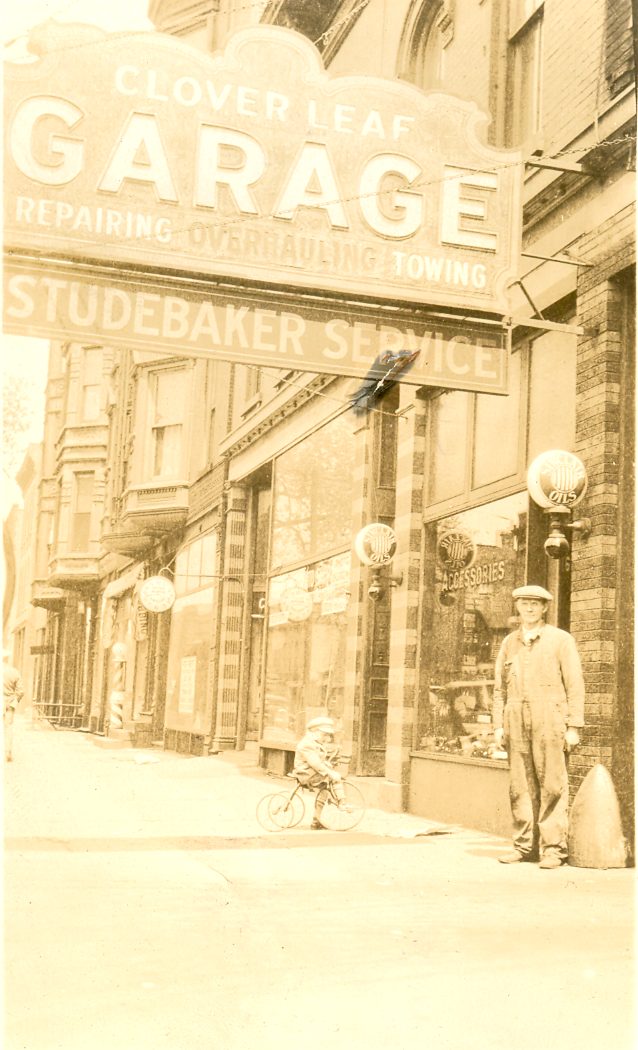
Here is an orphaned snapshot that caught my attention when I came across it recently in an antique shop. Unfortunately, there is no information as to when or where it was taken. You can click on the image to view it in greater detail.

My guess is it from sometime in the 1920s. The glass globe above the man's head and an identical globe on the other side of the window say "Sinclair Oils." The buildings are much older - from the last couple of decades of the 19th century. Presumably the man was either the owner or an employee of the garage. Is the child on the tricycle his? Or is it just some random kid who happened to be there when the photo was posed?

I like to think that somebody somewhere has another copy of this photo - somebody who either knows who the man and child in it were or at least the name of the city and street. Somebody obviously cared enough about it to preserve it for a good many decades. Yet, in the end, it was relegated to a box in the corner of some antique shop along with a few hundred other forgotten images waiting for someone like me to come along and fork over a dollar for it.

Monday, March 10, 2008

Busy

No, I have not abandoned the blog. But things have been busy. I have a few postings floating around in my head - it is just a matter of setting aside a bit of time to type them in.